 EN
EN fr
fr ha
ha nl
nl ru
ru hi
hi be
be he
he ar
ar az
az af
af vi
vi ja
ja th
th tr
tr de
de pt
pt es
es it
it sq
sq ko
ko tg
tg ky
ky rw
rw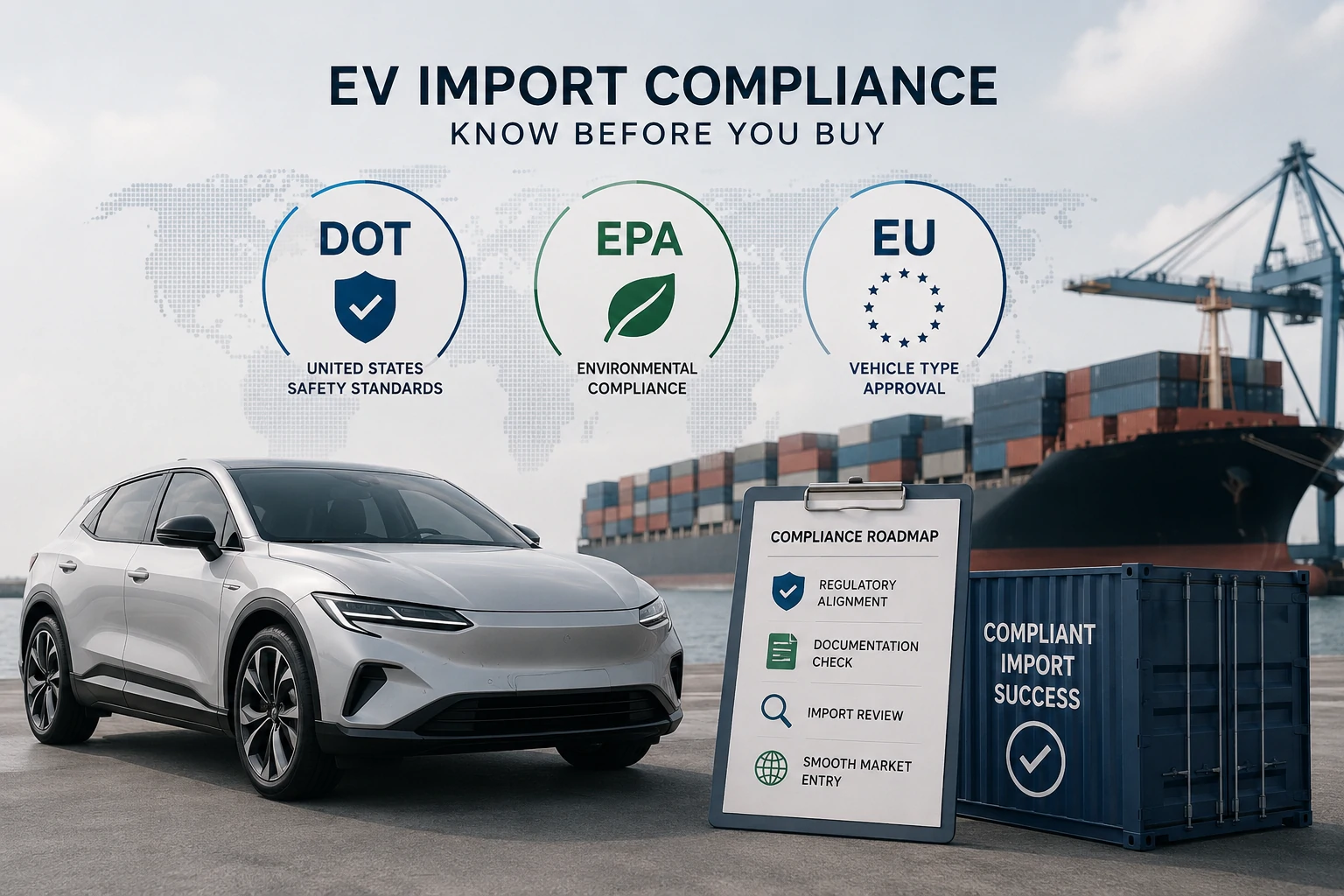
DOT, EPA, and EU Standards: What EV Importers Must Know Before Buying
The rapid growth of global EV trade and parallel vehicle imports has transformed the automotive landscape. As cross-border opportunities expand, many international dealers focus heavily on pricing but unfortunately overlook regulatory compatibility. This oversight introduces hidden risks of importing non-compliant electric vehicles. These dangers can manifest as sudden customs delays or outright registration rejection at the final destination. Furthermore, importers often face unexpectedly high modification costs, complex insurance and warranty complications, and severe legal liability. To mitigate these threats, it is critical to introduce the three major regulatory systems shaping international EV imports. These core systems encompass DOT standards in the United States, EPA environmental compliance, and EU vehicle type approval regulations. Ultimately, this article is designed to serve as a practical compliance roadmap for dealers sourcing EVs from overseas suppliers.
Understanding the Three Core Regulatory Systems
What DOT Standards Cover in Vehicle Imports
The U.S. Department of Transportation controls vehicle movement through American border points. The agency enforces safety-related compliance requirements to protect public health. The Department of Transportation regulates essential elements, which include lighting systems, complete crash safety systems, and seat belt and airbag performance. Vehicles must meet particular tire requirements, which include using approved glass and mirror materials and operating approved electronic safety devices.
All these mandates are part of the FMVSS (Federal Motor Vehicle Safety Standards), which are essentially the fundamental safety rules that dictate vehicle design and performance in the U.S.. Importers must remember a critical reality: why a vehicle that is road-legal in one country may still entirely fail DOT requirements.
What EPA Regulations Mean for Electric Vehicle Imports
The EPA's role in emissions and environmental compliance extends far beyond standard combustion engines. A common misconception plagues the industry: the false belief that "EVs have no emissions, so EPA does not matter". In truth, there are multiple EPA requirements that still affect EV imports. Dealers must navigate strict battery-related environmental compliance and submit accurate energy consumption reporting. The EPA also mandates specific vehicle labeling and requires robust manufacturing documentation. Lastly, the agency demands precise import documentation and declaration requirements to allow vehicles into the country.
What EU Standards Require for Imported EVs
To enter the European market, businesses need to understand the EU Whole Vehicle Type Approval (WVTA), which serves as a complete system that establishes consistent safety and environmental assessment standards. This intricate system connects CE requirements with the stringent homologation testing procedures. The main areas of EU compliance requirements show a strong emphasis on current automotive technological developments.
The regulations require complete compliance with all battery safety standards and all technical specifications related to battery recycling. European standards establish strict requirements for cybersecurity protection systems, ADAS technology, and charging interface connection standards. Importers need to recognize UNECE regulations because these rules currently shape European Union legislation, and they will expand their influence across various countries. The process of traveling through Europe requires people to learn about the specific distinctions that exist between EU-wide approval processes and the registration procedures used by individual nations.
Why EV Compliance Is More Complex Than Traditional Fuel Vehicle Imports
EVs Combine Automotive Regulations with Battery Regulations
Importing electric cars is uniquely difficult because EVs merge traditional vehicle rules with strict battery mandates. Lithium battery transport restrictions complicate logistics and raise shipping costs. Regulators enforce stringent high-voltage system safety requirements to protect consumers and mechanics alike. Authorities also prioritize fire prevention and thermal runaway concerns. Consequently, EV imports involve additional inspection layers at ports and customs facilities.
Software and Connectivity Are Now Regulatory Issues
Modern vehicles are computers on wheels, and connectivity presents new legal hurdles. Regulators scrutinize OTA (Over-the-Air) update systems to ensure they function securely. Strict vehicle cybersecurity regulations aim to prevent malicious hacking. Additionally, stringent data privacy requirements in Europe safeguard driver information. Together, these software mandates create significant connected vehicle approval challenges.
Charging Standards Create Cross-Market Compatibility Problems
Charging infrastructure remains highly fragmented, leading to global logistical headaches. Importers must navigate the divide between CCS1 vs CCS2 vs GB/T charging systems. Fast charging compatibility issues frequently arise when transferring vehicles between regions. Buying incompatible vehicles introduces severe infrastructure mismatch risks for dealers. Ultimately, the high cost of retrofitting imported EVs can easily destroy profit margins.
Key Differences Between U.S. and EU EV Compliance Standards
Safety Regulations: Similar Goals, Different Technical Requirements
While both regions strive for optimal road safety, a direct comparison between FMVSS and UNECE standards highlights diverging engineering philosophies.
| Component Category | Key Differences Between US and EU Compliance |
|---|---|
| Headlamp configuration | Differences exist regarding beam patterns and brightness limitations. |
| Side marker requirements | Color and placement rules differ heavily between regions. |
| Rear lighting | Turn signal colors (amber vs. red) frequently misalign. |
| Speedometer formats | Display metrics (mph vs. km/h) and exact calibration rules vary. |
Table: Highlighting differences in regional compliance standards.
These variations highlight why "minor" differences can block vehicle registration entirely.
Environmental and Battery Compliance Differences
The two markets approach sustainability differently. The U.S. relies on detailed EPA reporting vs EU sustainability directives that govern broader lifecycle impacts. Europe strictly enforces battery recycling obligations to minimize environmental waste. In addition, carbon footprint documentation trends are expanding rapidly across European jurisdictions.
Certification and Approval Processes Compared
Administrative hurdles vary drastically depending on the destination. The United States generally relies on self-certification in some U.S. cases, putting the onus on manufacturers. In contrast, EU homologation processes are rigid and pre-emptive. The European system requires direct testing authority involvement before vehicles reach the market. These contrasting approaches carry massive time and cost implications for importers trying to secure clearance.
Common Mistakes EV Importers Make Before Purchasing
Assuming All Export Vehicles Are Automatically Road-Legal
Many dealers wrongly believe that "export-ready does not equal import-compliant". There are massive differences between domestic-market EVs and export-market EVs, and assuming otherwise is a costly error.
Ignoring VIN and Certification Label Verification
Overlooking physical documentation is a critical failure. Dealers must recognize the importance of checking the precise VIN structure to confirm origin and spec. Buyers must also verify physical compliance labels and valid manufacturer certificates. The legal and financial risks of missing or altered documentation are simply too high to ignore.
Focusing Only on Vehicle Price Instead of Total Landing Cost
Bargain hunting often blinds dealers to reality. Ignoring the hidden compliance-related expenses leads to financial disaster. Importers must budget for mechanical retrofitting and mandatory third-party testing. Bureaucratic slowdowns result in painful storage fees and massive port delays. Ultimately, failure to account for these costs triggers severe re-export risks.
Buying Vehicles Without Local Charging Compatibility
An EV that cannot charge is useless inventory. Dealers must be wary of simple adapter limitations, which frequently fail to support fast-charging speeds. Furthermore, attempting to bypass these issues causes warranty complications caused by unofficial modifications.
Essential Documents EV Dealers Should Request Before Ordering
Before wiring any funds, professional importers demand comprehensive paperwork.
- Vehicle Compliance Certificates: Ensure you receive a Certificate of Conformity (CoC), required EPA declaration forms, proper DOT-related compliance documentation, and official homologation certificates.
- Battery and Safety Documentation: Shipping lines will demand the UN38.3 battery transport certification. You will also need corresponding MSDS documentation and precise battery origin records.
- Export and Customs Documentation: Customs agents require a commercial invoice, a valid bill of lading, a detailed packing list, and stamped export declarations.
- Software and Technical Information: Technical teams need proof of firmware compatibility and exact charging protocol specifications. Finally, verify that adequate service and diagnostic support availability exists in the destination country.
How Reliable EV Exporters Help Dealers Reduce Compliance Risks
Navigating these regulations requires seasoned partners. Partnering with professionals, such as the experts at HN Launch Car, streamlines the entire acquisition process.
Pre-Shipment Compliance Verification
Top-tier exporters guarantee a thorough VIN and certification checking before export. They also manage direct market-specific configuration confirmation so vehicles arrive ready for the road.
Market-Oriented Vehicle Sourcing
Experienced partners excel at selecting EV models already aligned with destination-country regulations. This strategic sourcing is the best method for avoiding high-risk gray-market inventory.
Coordination with Customs and Compliance Partners
Logistics experts thrive at working with local brokers and testing agencies. Their direct involvement is crucial for supporting homologation preparation smoothly and efficiently.
Providing Transparent Technical Documentation
Reputable supply chains understand why experienced exporters maintain complete compliance records. They prioritize the long-term importance of after-sales technical support to keep dealer networks functioning.
Practical Checklist Before Importing an Electric Vehicle
To guarantee a safe transaction, utilize this dual checklist methodology.
Regulatory Checklist for Dealers:
- Verify destination-market compliance
- Confirm charging compatibility
- Review certification labels
- Validate shipping documentation
- Confirm local registration eligibility
- Estimate retrofit costs before purchase
Supplier Evaluation Checklist:
- Assess export experience by target market
- Verify compliance support capability
- Review technical documentation quality
- Confirm after-sales coordination ability
Conclusion: Compliance Knowledge Protects EV Import Profitability
To thrive in the modern automotive trade, dealers must reaffirm that EV importing is no longer just a logistics transaction. A company's regulatory readiness directly impacts its financial survival and operational success. Compliance heavily dictates profit margins, delivery timelines, customer satisfaction, and dealer reputation. We strongly emphasize the value of partnering with experienced EV exporters familiar with DOT, EPA, and EU standards. We encourage dealers to evaluate compliance strictly before placing orders rather than after vehicles arrive.
FAQs
1. Can an EV approved in China be legally registered in the United States?
Not automatically. Even if an EV is approved and safe in China, it must undergo testing and modifications to meet strict DOT (FMVSS) safety standards and EPA environmental requirements before it can be legally registered in the U.S.
2. What documents are required to import electric vehicles into Europe?
Key documents include the Certificate of Conformity (CoC), UN38.3 battery transport certification, a commercial invoice, bill of lading, and comprehensive technical documentation proving compliance with EU Whole Vehicle Type Approval (WVTA).
3. Do electric vehicles need EPA approval?
Yes. Despite having zero tailpipe emissions, electric vehicles still require EPA approval to ensure compliance regarding energy consumption reporting, battery environmental standards, and proper vehicle labeling.
4. What is the difference between FMVSS and UNECE standards?
FMVSS are the federal safety regulations mandated by the United States (DOT), whereas UNECE standards are utilized by the European Union and many other global markets. They differ significantly in technical requirements for components like headlamps, speedometers, and rear lighting.
5. How can dealers verify whether an imported EV is compliant?
Dealers should execute a robust compliance checklist. This includes checking the VIN structure, physically reviewing certification labels, validating the Certificate of Conformity, and working closely with a reliable EV exporter or local customs broker.
Hot News

Nissan and Infiniti recall 1.2 million vehicles
November 28, 2023
Best Wholesale Cars From China for Your Business
February 03, 2026

Discover Cheap Cars for Import From China
February 09, 2026
Bulk Purchase Benefits of Chinese Vehicles Explained
February 19, 2026
Bulk Car Suppliers in China: What You Need to Know
February 23, 2026
Wholesale Car Sales Growth in China's Vehicle Market
March 30, 2026
Industry information
Nissan and Infiniti recall 1.2 million vehicles
November 28, 2023

2023 BMW i7 Review: Smooth Operator, Tricky Technology
December 04, 2023
Hidden Costs of Importing EVs from China: What Buyers Often Overlook
April 30, 2026
FOB vs CIF vs DDP in Car Export: Which Pricing Term Is Best for You
April 30, 2026

Meeting Along the Silk Road, Driving Toward the Future | Longchuang Automobile Appears at the Belt and Road Business Exchange Conference
May 15, 2026