 EN
EN fr
fr ha
ha nl
nl ru
ru hi
hi be
be he
he ar
ar az
az af
af vi
vi ja
ja th
th tr
tr de
de pt
pt es
es it
it sq
sq ko
ko tg
tg ky
ky rw
rw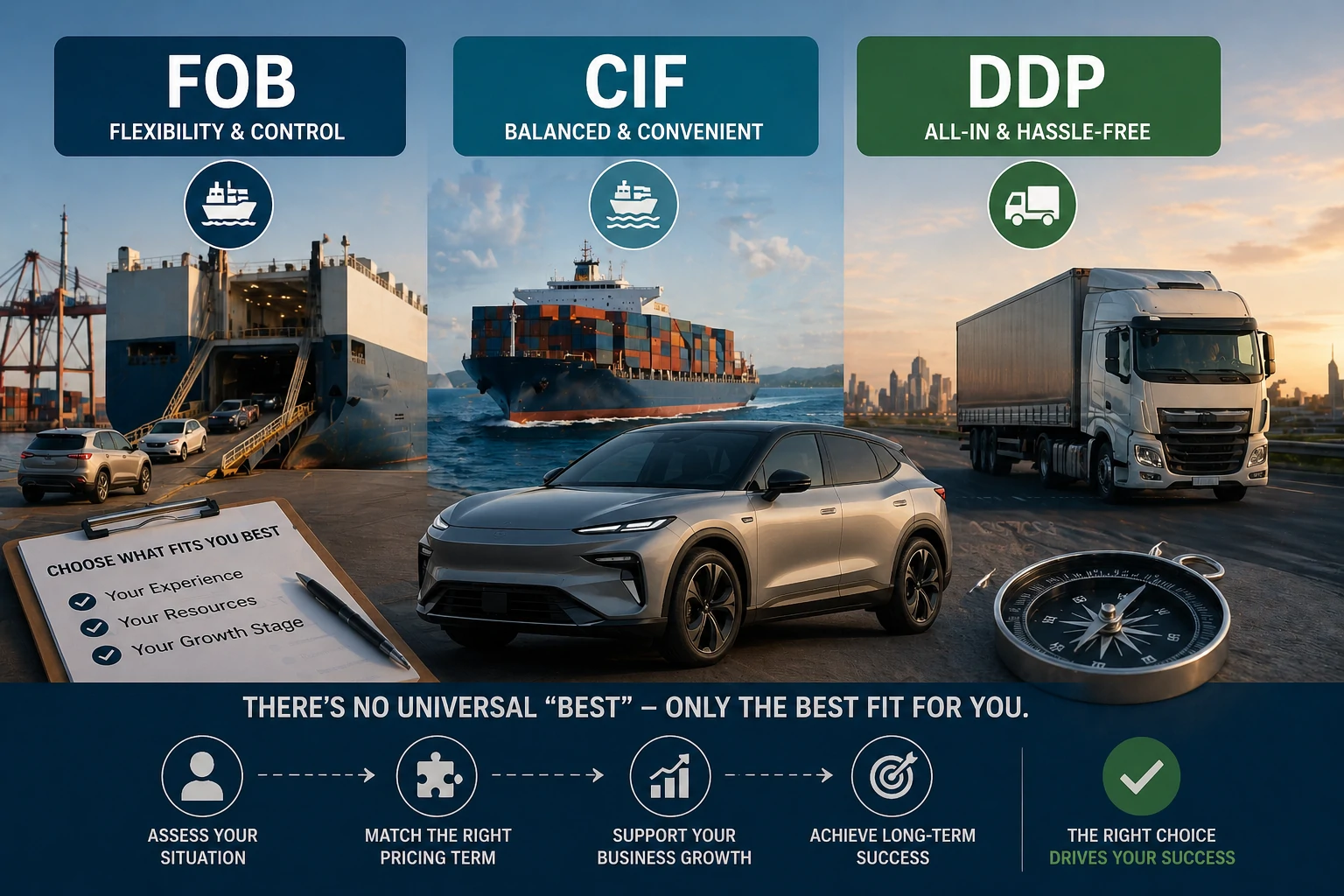
FOB vs CIF vs DDP in Car Export: Which Pricing Term Is Best for You
I. Why Your Incoterm Choice Shapes the Entire Deal
Many disputes in car exports originate from misunderstood pricing terms. Buyers frequently look at a quotation and focus entirely on the final number. They view FOB, CIF, and DDP merely as price tags. However, these three acronyms define much more than just the final cost. They explicitly define the exact scope of responsibility for both parties. They determine the exact moment of risk ownership transfer. Furthermore, they establish the level of operational control you hold over the entire shipment. A simple misunderstanding here can easily cost your business thousands of dollars. The core question you must ask yourself is simple. Are you simply buying a car, or are you managing a complex supply chain?. Your answer to this fundamental question will dictate which Incoterm is truly right for your business.
II. A New Way to Understand Incoterms: The “Control vs Convenience Spectrum”
Instead of relying on standard dictionary definitions, let us look at Incoterms through a unique conceptual framework. We can position the three main terms along a "Control vs Convenience Spectrum". This spectrum helps visualize the necessary trade-offs.
- FOB (Free on Board): This term sits at one end of the spectrum. It offers maximum control over the logistics process, but it requires a higher level of responsibility from the buyer.
- CIF (Cost, Insurance, Freight): This term sits in the middle. It provides a strategic balance between operational control and convenience.
- DDP (Delivered Duty Paid): This term sits at the opposite end. It requires minimum effort from the buyer, but it offers the lowest level of control over the process.
Moving along this spectrum fundamentally shifts your overall business experience. It directly shifts your level of cost transparency. It alters your risk exposure during transit. Finally, it dictates your operational workload and the size of the team you need to succeed.
III. The Same Shipment, Three Different Realities
Let us imagine importing the exact same electric vehicle (EV) from China under three different terms. This scenario-based comparison reveals the practical differences much better than standard definitions.
- Scenario A: FOB (Free on Board): The buyer actively manages the shipping, the insurance policies, and the entire import process. The exporter’s role ends completely once the vehicle is securely loaded onto the vessel at the origin port. The buyer handles everything from that moment forward.
- Scenario B: CIF (Cost, Insurance, Freight): The exporter handles the complex shipping logistics and secures the maritime insurance. The buyer then takes over the process once the vehicle arrives at the designated destination port. The buyer must handle local customs and inland delivery.
- Scenario C: DDP (Delivered Duty Paid): The exporter manages the entire journey right to the buyer’s doorstep. The buyer receives a near “ready-to-sell” vehicle without actively handling any of the logistics or customs paperwork.
The key insight here is crucial for every importer to understand. The vehicle remains identical in all three scenarios, but the actual business experience is completely different.
IV. Breaking Down Responsibility Transfers (Where Risk Actually Moves)
Understanding exactly where risk transfers is essential for your financial safety. You must know these critical handover points to prevent costly disputes.
- FOB: The risk transfers completely to the buyer at the origin port once the car is physically placed on the ship. If the ship sinks, the buyer claims the loss.
- CIF: The risk transfers at shipment, the exact moment the vehicle is loaded. This happens despite the fact that the seller arranges and pays for the freight. This remains the most misunderstood rule in shipping.
- DDP: The seller carries the risk entirely until final delivery at the agreed destination. The seller assumes all liability during the entire transit period.
A common misunderstanding frequently traps buyers using CIF terms. CIF includes insurance, but it does not guarantee full protection for the buyer against every possible scenario. You must emphasize knowing exactly when risk transfers, because this knowledge matters more than the initial quoted price.
V. Cost Visibility vs True Cost Control
Let us analyze these terms through a fresh analytical angle regarding your actual costs.
- FOB: This option provides the highest level of cost transparency. You see every invoice from the freight forwarder and the shipping line. However, it requires significant buyer expertise to successfully avoid hidden costs like demurrage or port fees.
- CIF: This option offers only moderate transparency. Some logistics costs are bundled together by the seller, which effectively reduces your overall visibility into the actual freight expenses. You might easily pay a premium for this bundling.
- DDP: This term offers the absolute lowest transparency. It appears very simple on the surface as one lump sum. However, it may include hidden margins padded by the seller to cover unexpected risks.
The key insight here changes how buyers negotiate. Transparency does not automatically equal lower cost. Likewise, convenience does not always mean you are getting better value for your money.
VI. Matching Incoterms to Your Business Model
You must match your chosen Incoterm to your specific business capabilities and scale.
- New Importers or Small Dealers: These businesses usually have limited logistics experience. They lack dedicated shipping teams. Therefore, we highly recommend using DDP or CIF. This approach greatly reduces operational complexity for smaller teams. It allows them to focus purely on selling cars.
- Growing Dealers Expanding Volume: These companies possess some logistics knowledge. They import vehicles regularly. For these buyers, we recommend a strategic transition from CIF to FOB. This transition creates a healthy balance between maintaining control and ensuring operational efficiency.
- Large Importers or Distributors: These organizations have an established logistics network and dedicated personnel. We strongly recommend FOB for this tier of business. This choice allows them to maximize cost control and maintain maximum flexibility over their supply chain.
VII. EV-Specific Considerations When Choosing FOB, CIF, or DDP
Electric vehicles introduce a unique set of challenges tailored specifically to this modern niche. Internal combustion engine rules do not apply perfectly here. Battery shipping regulations require specialized hazardous goods handling. Lithium-ion batteries demand strict global compliance. Furthermore, EVs demand specialized insurance requirements to adequately cover their high-value components. Standard automotive insurance often falls short. Buyers must also navigate strict port restrictions and rigorous local compliance checks upon arrival. EV software systems frequently require careful technical inspection and regional updates before final delivery. The core insight is clear and unavoidable. EV exports significantly increase the complexity gap between FOB, CIF, and DDP decisions.
VIII. Hidden Risks Behind Each Term (What Suppliers Don’t Always Explain)
Suppliers do not always explain the inherent risks hiding behind each Incoterm. Buyers must proactively understand these dangers.
- FOB Risks: Buyers face the significant risk of poor freight coordination if they choose a bad forwarder. They may also encounter unexpected destination charges at the local port. Furthermore, they often face severe responsibility gaps if communication breaks down.
- CIF Risks: Importers have very limited control over the shipping quality and transit time. The seller might choose the slowest vessel to save money. Importers also often receive only basic, minimum insurance coverage. Potential delays can easily occur without any clear accountability from the supplier.
- DDP Risks: Buyers often pay a premium for overpriced bundled services. The convenience comes at a steep price. There is a complete lack of cost breakdown transparency. Finally, the buyer relies heavily and entirely on the exporter’s network reliability.
IX. Strategic Decision Framework: How to Choose the Right Term
We offer a decision-tree style guidance system to help you choose wisely. You should sit down and ask yourself the following critical questions:
- Do you currently have a trusted freight forwarder?
- Are you thoroughly familiar with the import regulations in your specific country?
- Do you prioritize strict cost control over operational simplicity?
- Can your internal team successfully handle customs clearance and local compliance?
You must then apply this straightforward decision logic. If you answer “yes” to most of these questions, you should definitely choose FOB. If your answers are a mixed combination of yes and no, you should choose CIF. If you answer “no” to most of these crucial questions, you should choose DDP.
X. The Role of a Professional Export Partner
Experienced exporters actively reduce risks across all available Incoterms. A good partner acts as a shield for your business. They provide immense value that extends far beyond just the initial pricing. First, they ensure strict documentation accuracy to prevent customs holds. Second, they provide seamless logistics coordination from the factory to the port. Third, they offer deep, specialized compliance expertise. The key insight here changes the perspective entirely. The right partner can make FOB feel as effortless as DDP. Alternatively, they can completely prevent a DDP shipment from becoming unnecessarily costly.
XI. Common Mistakes Dealers Make When Choosing Incoterms
Automotive dealers frequently make avoidable, costly mistakes. Many buyers select their shipping term based purely on the lowest quoted price. This is a dangerous trap. They often ignore the crucial responsibility boundaries established by the terms. Buyers routinely underestimate the vast complexity of local import regulations and hidden taxes. Finally, many businesses fail completely to align their chosen Incoterms with their actual internal business capabilities.
XII. Conclusion: The Best Incoterm Is the One That Matches Your Capability
There is absolutely no universal “best” option in the global automotive trade. There is only the best fit for your specific, unique situation. Buyers must realize that FOB, CIF, and DDP are simply tools, not complete, magical solutions. The final takeaway is vital for your ongoing success. You must carefully align your pricing term with your experience, your available resources, and your company's current growth stage.
We invite you to request a customized Incoterm recommendation tailored specifically for your next shipment. Contact us today to get a full, transparent cost comparison between FOB, CIF, and DDP. Consult directly with our expert team on complex EV export logistics. HN Launch Car serves proudly as your flexible export partner. We are fully capable of supporting all three pricing models flawlessly. We remain deeply focused on reducing your risk and dramatically improving your overall cost efficiency.
FAQs
1. What is the main difference between FOB and CIF in car exports?
FOB requires the buyer to manage shipping and insurance, giving them full control once the car is loaded onto the vessel. CIF means the seller arranges the freight and basic insurance, but the risk still transfers to the buyer the moment the car is loaded at the origin port.
2. Is DDP the safest option for new car importers?
Yes, DDP is generally the safest and easiest option for beginners because it requires minimum effort. The exporter handles the complex shipping journey, customs duties, and delivery, providing a near "ready-to-sell" vehicle directly to you.
3. Do EV batteries affect which Incoterm I should choose?
Absolutely. Electric vehicles introduce severe complexity. EV batteries have strict shipping regulations that require specialized hazardous goods handling. This complexity makes it riskier to choose FOB unless you have a highly experienced freight forwarder who understands lithium-ion compliance.
4. Why does risk transfer at shipment for CIF, even though the seller pays for freight?
This is a standard international trade rule. Under CIF, the seller pays for the logistics to get the car to your port, but they do not guarantee its safe arrival. If the vessel encounters a storm and the car is damaged, the risk has already transferred to you, and you must file the insurance claim.
5. How can HN Launch Car help me decide between FOB, CIF, and DDP?
Our expert team acts as a flexible export partner capable of supporting all three pricing models. We provide a customized Incoterm recommendation based on your business size, offer a full cost comparison, and handle all the logistics coordination and compliance expertise to ensure a smooth import.
Hot News

Nissan and Infiniti recall 1.2 million vehicles
November 28, 2023
Best Wholesale Cars From China for Your Business
February 03, 2026

Discover Cheap Cars for Import From China
February 09, 2026
Bulk Purchase Benefits of Chinese Vehicles Explained
February 19, 2026
Bulk Car Suppliers in China: What You Need to Know
February 23, 2026
Wholesale Car Sales Growth in China's Vehicle Market
March 30, 2026
Industry information
Nissan and Infiniti recall 1.2 million vehicles
November 28, 2023

2023 BMW i7 Review: Smooth Operator, Tricky Technology
December 04, 2023
Hidden Costs of Importing EVs from China: What Buyers Often Overlook
April 30, 2026
FOB vs CIF vs DDP in Car Export: Which Pricing Term Is Best for You
April 30, 2026

Meeting Along the Silk Road, Driving Toward the Future | Longchuang Automobile Appears at the Belt and Road Business Exchange Conference
May 15, 2026