 EN
EN fr
fr ha
ha nl
nl ru
ru hi
hi be
be he
he ar
ar az
az af
af vi
vi ja
ja th
th tr
tr de
de pt
pt es
es it
it sq
sq ko
ko tg
tg ky
ky rw
rw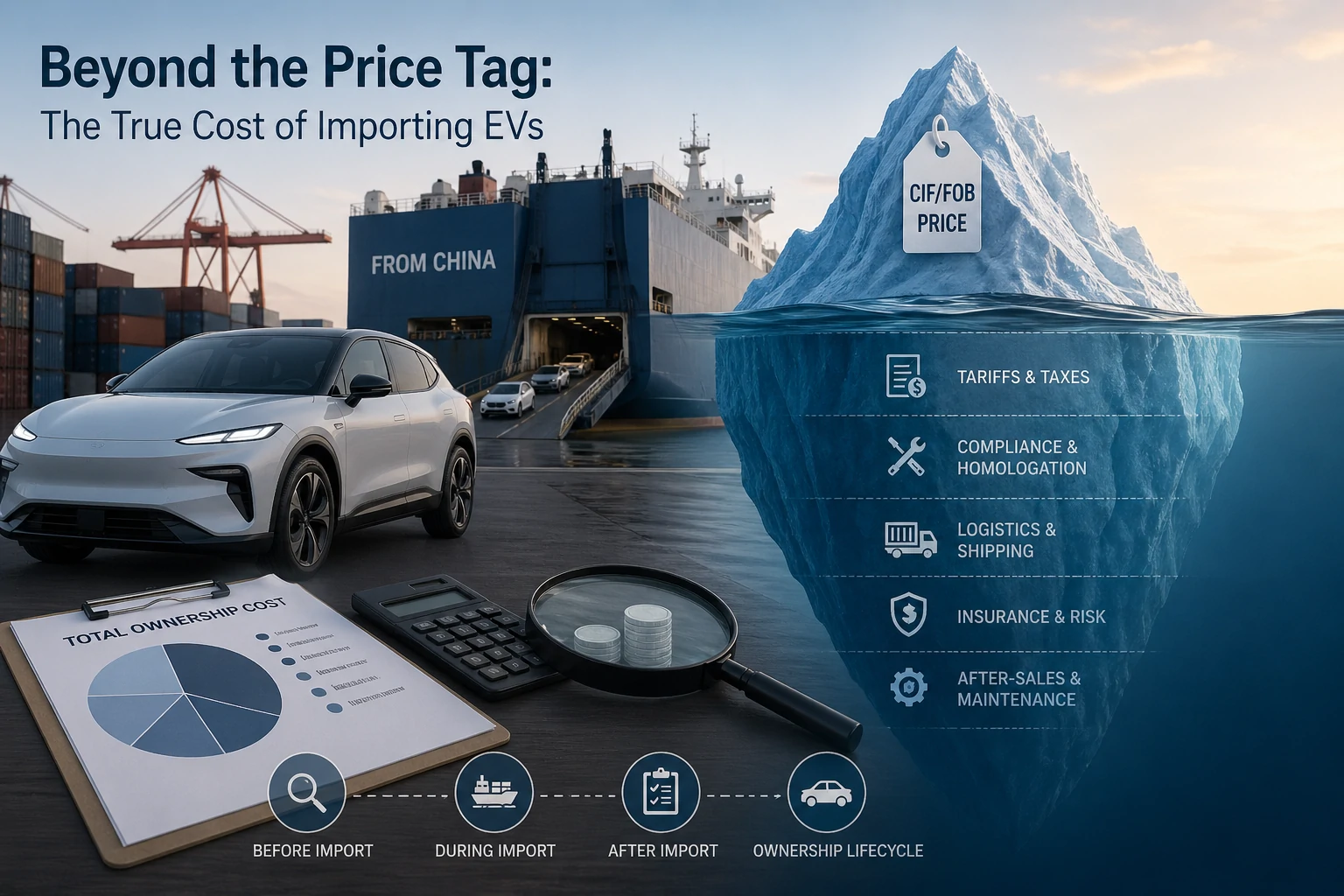
Hidden Costs of Importing EVs from China: What Buyers Often Overlook
Many buyers start their import journey with a common misconception. They focus only on the CIF or FOB pricing. This visible price is just a fraction of the total ownership cost. Smart buyers must understand the invisible cost layers. These layers remain hidden before, during, and after the import process. This article provides a full lifecycle cost breakdown. We will expose the true expenses of importing electric vehicles.
Phase 1: Pre-Purchase Costs That Quietly Inflate Your Budget
The total expenses for your project begin to rise before you place your first order.
- The process of evaluating suppliers requires both financial resources and time since buyers need to authenticate third-party systems and factory operations through paid assessments.
- The process of ordering vehicles which do not comply with local regulations results in financial penalties because of incorrect vehicle specifications. The two outcomes for your business will result in either expensive reconfiguration work or significant financial losses when you need to sell your products.
- The unpredictability of exchange rates between the initial price quote and the final payment date will lead to complete destruction of your profit margins. Your budget becomes exposed to financial risks because you lack any hedging strategies.
- The process of waiting to make your choice results in lost financial resources. You risk losing the allocation of high-demand EV models. Furthermore, price increases occur because sudden market shifts cause unexpected changes in demand.
Phase 2: Transaction-Level Hidden Costs
Hidden expenses are often embedded within the deal itself.
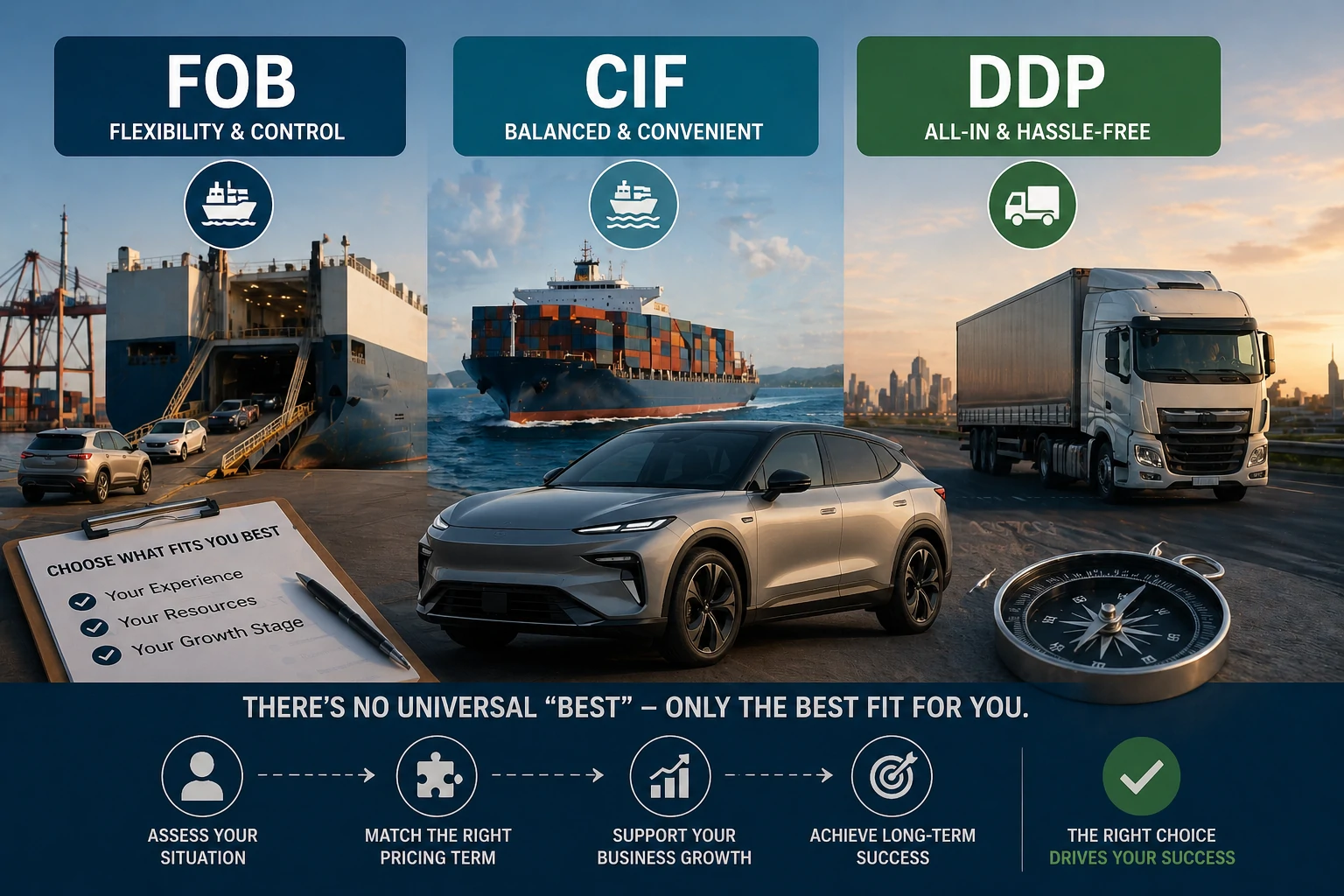
- Pricing Structure Gaps: Buyers frequently misunderstand the differences between EXW, FOB, CIF, and DDP. Quotes might miss critical line items like handling fees, documentation, and inland transport.
- Payment Processing Costs: International finance is not free. Bank transfer fees eat into profits. Letter of credit charges add another layer of expense. Payment delays can also impact shipment schedules negatively.
- Contract Ambiguities: Weak contracts leave responsibilities undefined for damage, delays, or compliance failures. The financial impact of weak contract terms can be devastating.
Phase 3: Logistics and Shipping Cost Surprises
The shipping phase is where most unexpected costs appear.
- Port and Terminal Charges: Destination handling fees are rarely included in the initial quote. Delays quickly lead to expensive storage and demurrage fees.
- Inefficient Shipping Decisions: Choosing between container and RoRo shipping without cost optimization wastes money. Shipping partial container loads significantly increases the per-unit cost.
- Insurance Gaps: Underinsured shipments carry massive risk. Importers face complex claims processes and uncovered losses if an accident occurs.
- Customs Clearance Complications: The misclassification of EVs causes major headaches. This error triggers unexpected duties, taxes, or penalties.
Phase 4: Compliance and Regulatory Costs
First-time importers often underestimate compliance expenses.
- Certification and Homologation: Importers must pay to meet local EV standards. Testing, documentation, and approval delays add substantial costs.
- Policy Variability Across Markets: Import restrictions or sudden regulatory changes can trap your inventory. Regional incentives often require strict, costly compliance measures.
- Environmental and Battery Regulations: Buyers face disposal or recycling compliance obligations. Importers also need additional certification for lithium-ion batteries.
Phase 5: Post-Arrival and Operational Costs
These expenses are the most overlooked but have long-term impacts.
- Battery Health and Performance Risk: Degradation issues commonly affect pre-owned EVs. Buyers face the high cost of replacement or frustrating warranty disputes.
- Software and Compatibility Issues: Many EVs feature region-locked systems. Importers must budget for the need for updates or complete reprogramming.
- Spare Parts and Maintenance Supply Chain: Delays in sourcing components keep cars off the road. The high cost of low-volume parts squeezes profit margins.
- Technician Training and Support: Many regions suffer from a lack of local expertise in EV systems. Dealerships must make an investment in training or external support.
The “Hidden Cost Multiplier” Effect
Small overlooked costs compound rapidly. We call this the "Hidden Cost Multiplier." A single delay triggers expensive storage fees. These fees lead to customer dissatisfaction and ultimately result in lost sales. Inefficiencies multiply across the entire supply chain. The total cost is not simply additive. Poor coordination exponentially affects the final expense.
Case Comparison: Low Price vs. True Cost
| Cost Category | Scenario A: Cheap Supplier | Scenario B: Reliable Partner |
|---|---|---|
| Initial Price | Lowest upfront price | Fair market price |
| Logistics | Unexpected fees, inefficient shipping | Optimized routing, flat fees |
| Compliance | Delays, failed homologation | Pre-certified, documentation ready |
| After-Sales Issues | No warranty support, part delays | Full parts supply chain, tech support |
| Total Cost (3-6 Months) | Highest total cost | Lowest total cost |
The lowest upfront price often leads to the highest total cost over a 3 to 6 month period.
How to Minimize Hidden Costs When Importing EVs
- Work with End-to-End Exporters: Choose partners who offer integrated sourcing, logistics, and after-sales support.
- Demand Full Cost Transparency: Always request itemized quotations. Require a clear Incoterms explanation before signing agreements.
- Validate Vehicle Data Before Shipment: Request comprehensive battery reports. Secure all inspection documentation early.
- Plan for Local Market Compatibility: Ensure vehicles meet all destination requirements before they leave China.
- Build Long-Term Supply Relationships: Strong partnerships reduce variability and unexpected costs over time.
Why EV Imports Require a Different Cost Mindset
EVs are not just vehicles. They are advanced technology platforms. They have a higher sensitivity to battery condition. They rely heavily on software ecosystems. They require strict regulatory compliance. Because of these factors, buyers need specialized exporters, not generic traders.
Conclusion: From Price Focus to Cost Intelligence
Importing EVs successfully depends on understanding the full cost lifecycle. Buyers must shift their mindset. Stop asking, “Who is cheapest?” Instead, ask, “Who is most reliable and transparent?”. Hidden costs can be controlled. However, you can only control them with the right partner.
Partner with True EV Export Experts
Do not let hidden costs ruin your margins. We invite you to request a full cost breakdown today. Let us build a tailored EV sourcing plan for your business. Consult our team on compliance and logistics. We act as a transparent partner and a risk-reduction specialist. We are your premier end-to-end EV export solution provider. Visit HN Launch Car to start your optimized import journey today.
FAQs
1. Why is the landed price of an EV higher than the factory quote?
The factory quote usually only covers the vehicle itself. The true landed price includes hidden logistics, customs duties, insurance gaps, and compliance fees that accumulate during transit.
2. How do battery regulations impact import costs?
EVs use lithium-ion batteries. These batteries require special environmental certifications and hazardous materials handling. Failing to comply can result in massive fines, certification delays, or shipment rejections.
3. What is the "Hidden Cost Multiplier" effect?
It is a compounding financial chain reaction. For example, a missing document causes a customs delay. The delay causes port storage fees. The delayed delivery causes customer dissatisfaction and lost retail sales.
4. Why do I need to worry about software in an imported EV?
Many Chinese EVs have region-locked software ecosystems. Updating mapping, language, and infotainment systems for local compatibility requires specialized reprogramming, which adds post-arrival operational costs.
5. How can I avoid unexpected costs when importing EVs from China?
Work with an integrated, end-to-end export partner. A specialized exporter provides transparent pricing, validates vehicle compliance before shipping, and offers comprehensive logistics support to eliminate surprises.
Hot News

Nissan and Infiniti recall 1.2 million vehicles
November 28, 2023
Best Wholesale Cars From China for Your Business
February 03, 2026

Discover Cheap Cars for Import From China
February 09, 2026
Bulk Purchase Benefits of Chinese Vehicles Explained
February 19, 2026
Bulk Car Suppliers in China: What You Need to Know
February 23, 2026
Wholesale Car Sales Growth in China's Vehicle Market
March 30, 2026
Industry information
Nissan and Infiniti recall 1.2 million vehicles
November 28, 2023

2023 BMW i7 Review: Smooth Operator, Tricky Technology
December 04, 2023
Hidden Costs of Importing EVs from China: What Buyers Often Overlook
April 30, 2026
FOB vs CIF vs DDP in Car Export: Which Pricing Term Is Best for You
April 30, 2026

Meeting Along the Silk Road, Driving Toward the Future | Longchuang Automobile Appears at the Belt and Road Business Exchange Conference
May 15, 2026