 EN
EN fr
fr ha
ha nl
nl ru
ru hi
hi be
be he
he ar
ar az
az af
af vi
vi ja
ja th
th tr
tr de
de pt
pt es
es it
it sq
sq ko
ko tg
tg ky
ky rw
rw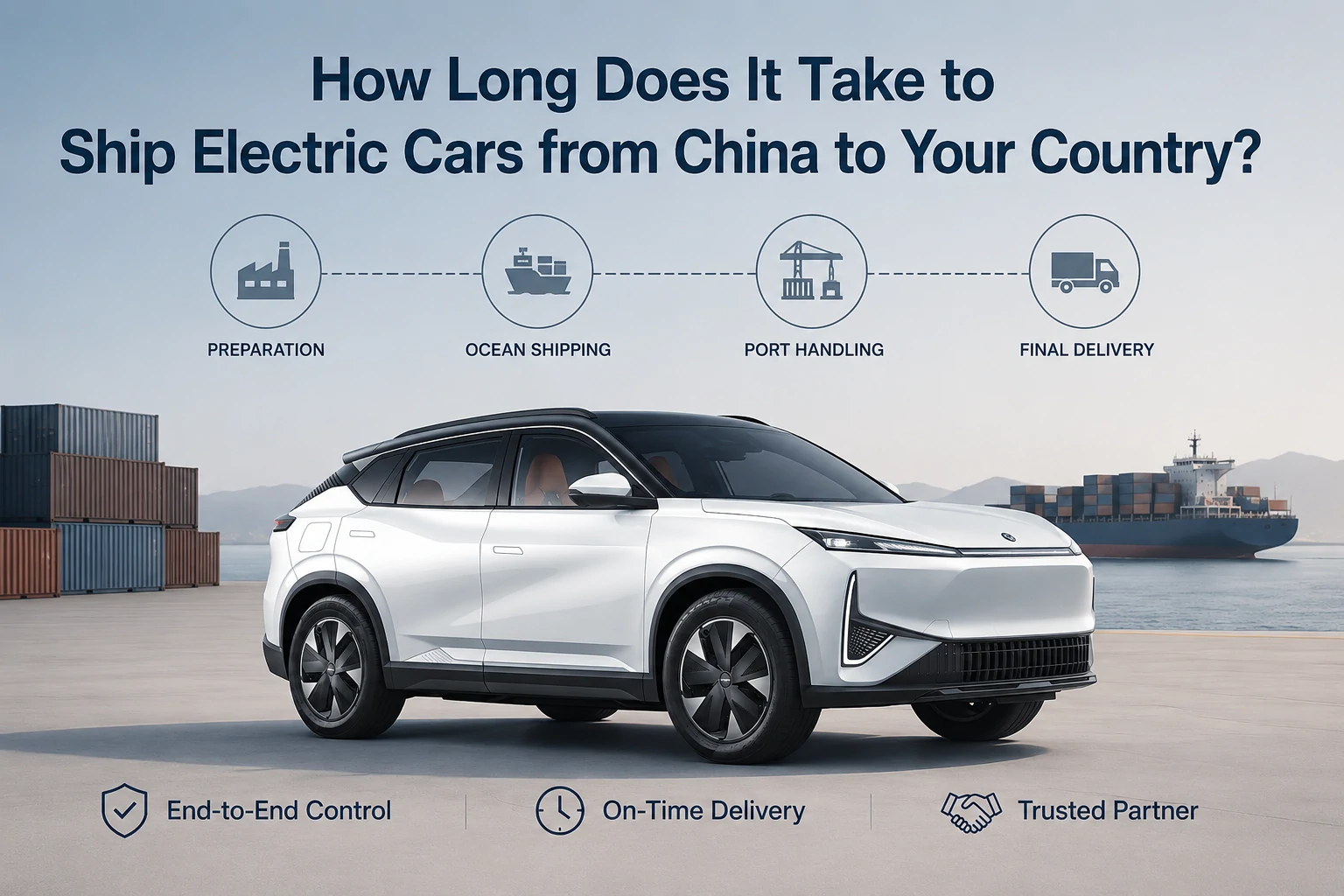
How Long Does It Take to Ship Electric Cars from China to Your Country?
All automotive dealers understand that their inventory planning requires absolute certainty. The first question about your global electric vehicle (EV) sourcing plans will emerge after you decide which countries to source from. All car sales depend on the condition that vehicles must remain free from all shipping blockages. This question needs to undergo proper redefinition. The process of shipping electric cars from China involves more than just measuring the time during which the ships travel across the ocean. The complete delivery process from the manufacturing facility to the dealership includes all activities from shipment preparation through ocean transportation and port operations, and final delivery to the dealership.
This article provides a complete, detailed timeline of the China electric vehicle export process through its various delivery routes. The guide enables you to conduct precise inventory planning through the detailed inventory guide. HN Launch Car, as a trusted China EV export partner, controls the complete automotive supply chain process to guarantee your vehicles will reach their destination on time and in perfect condition.
1. Typical Ocean Transit Times by Major Route
The ocean voyage represents the most visible part of the electric car shipping process from China to its final destination. Different destination regions require different transit times because of variations in distance, shipping lanes, and port congestion. The typical sea transit durations from major Chinese RORO and container ports like Shanghai or Guangzhou are shown in the following table.
| Destination Region | Estimated Ocean Transit | Route Notes |
|---|---|---|
| Southeast Asia | 7–15 days | Fast transit lanes to Vietnam, Thailand, and Indonesia. |
| Australia / New Zealand | 14–22 days | One of the fastest global corridors for NEV imports. |
| Middle East | 18–25 days | Standard routing via the Indian Ocean to the UAE and Saudi Arabia. |
| East Africa | 22–30 days | Routes to Kenya, Ethiopia, and Tanzania; subject to variable port congestion. |
| Europe | 28–38 days | Routes to Rotterdam, Hamburg, and Antwerp. Red Sea rerouting may extend times by 7–10 days. |
| Latin America | 30–45 days | Varies significantly depending on Pacific or Panama Canal routing to Chile, Peru, or Mexico. |
It is vital to remember that these figures reflect pure ocean transit only. A vessel might reach the destination port in three weeks, but the full delivery timeline will always be longer. The actual vehicle delivery depends heavily on what happens before the ship departs and after it arrives.
2. The Pre-Shipment Phase: What Happens Before the Car Leaves China
Many dealers mistakenly assume that transit time equals total lead time. This is a critical distinction you must understand for accurate order planning. The car export from China process involves several mandatory steps before a vehicle ever drives onto a ship.
First, the vehicle sourcing process and factory inspection process require extended periods of execution. A pre-purchase inspection (PPI) generally requires 3 to 7 days. This step is especially critical when exporting used EVs and hybrids to verify battery health and structural integrity. The next step involves creating the required documents for exporting electric vehicles. The process for obtaining customs declaration, together with commercial invoice, certificate of origin, and required EV battery safety certifications, needs approximately 5 to 10 business days to complete.
The port booking process starts after all documents have been completed. The process of moving vehicles from the factory or warehouse requires 3 to 5 days to reach a major departure port, which includes Shanghai, Tianjin, Guangzhou, and Yantian. The process of scheduling vessels operates as a critical component of maritime operations. RORO and container vessels operate according to weekly or bi-weekly departure schedules. The timeline for your project will experience a 7 to 14 day delay when you miss the cutoff date for your vessel. We handle the entire pre-shipment process through a partnership with HN Launch Car, which helps us achieve better documentation results while reducing shipment delays.
3. 7 Variables That Can Shorten — or Lengthen — Your Delivery Window
Several dynamic factors influence the total shipping time. Understanding these variables allows you to better anticipate the actual arrival date of your automotive inventory.
- Shipping Method: You must choose between RORO and container car shipping. RORO offers faster loading and lower costs, while container shipping provides better protection from the elements and is often preferred for premium or luxury EVs.
- Port of Loading: Your choice of departure port matters. Shanghai and Guangzhou offer the most frequent sailing schedules for EVs heading overseas. Meanwhile, Tianjin better suits northern China sourcing.
- Battery State of Charge (SOC): EV battery shipping regulations are notoriously strict. IATA and IMO regulations require the lithium battery SOC to be at or below 30% for safe sea transport. Discharging the battery adds time if not managed early in the process.
- Destination Port Clearance Times: Car import customs clearance time varies wildly. Some markets, such as West Africa or South America, have unpredictable customs dwell times that can last from 7 to 21 days or more.
- Import Compliance: Type approval, homologation, and emissions certificate requirements vary by country. Incomplete paperwork will inevitably cause costly port holds and delay final delivery.
- Order Volume: Bulk consignments may require consolidation windows before shipping. Conversely, single units can often secure faster spot bookings on departing vessels.
- Seasonal Factors: National Chinese holidays severely impact shipping logistics. For example, a Chinese New Year shipping delay in January or February, or the Golden Week holiday in October, can cause industry-wide slowdowns lasting 2 to 4 weeks.
4. Realistic End-to-End Timelines by Destination Region
The pre-shipment phases together with their variable factors allow us to establish accurate total timeline calculations. The electric vehicle import timeline shows you actual timeframes that result when you combine preparation time with transit time and destination clearance time.
- Southeast Asia: Pre-shipment takes about 10 days, transit requires 7 to 15 days, and port clearance adds 7 to 14 days. The total lead time is typically 24 to 39 days.
- Australia / New Zealand: Pre-shipment requires roughly 12 days, transit takes 14 to 22 days, and clearance takes 5 to 10 days. Expect a total of 31 to 44 days for a China car export to Australia.
- Middle East (UAE / Saudi Arabia): Pre-shipment takes about 14 days, transit needs 18 to 25 days, and clearance takes 5 to 10 days. The total timeline spans 37 to 49 days.
- Europe: Pre-shipment takes 14 days, transit requires 28 to 38 days, and clearance adds 7 to 21 days. The total delivery ranges from 49 to 73 days, factoring in potential Red Sea disruption scenarios.
- East & West Africa: Pre-shipment takes roughly 14 days, transit requires 22 to 35 days, and clearance often spans 14 to 30 days. This creates the widest variance, totaling 50 to 79 days due to developing port infrastructure.
As a practical takeaway, you should plan to quote your retail customers using the upper end of these ranges. The process of managing expectations upfront will create positive results that help to avoid later frustration.
5. How to Compress Your Lead Time: 5 Strategies for Smart Dealers
You do not have to accept delays as inevitable. Proactive dealers use specific strategies to speed up car shipping from China and optimize their automotive supply chain.
- Prepare Import Documentation in Advance: Work with your export partner to pre-clear paperwork and compliance requirements before the vehicle is even sourced.
- Choose Ports Strategically: Align your departure and arrival ports with vessels that have the most frequent sailing schedules. This cuts waiting time at the docks significantly.
- Order in Consolidated Batches: Shipping multiple units per shipment unlocks priority loading slots. It also helps build better carrier relationships with RORO lines.
- Engage a Specialist Export Partner Early: Generalist freight forwarders often lack EV-specific battery SOC management and automotive documentation expertise. A specialized partner streamlines these unique hurdles.
- Plan Around Chinese Calendar Holidays: Ensure your orders are confirmed and documented well before Chinese New Year cutoff dates. This helps you avoid the 3 to 5-week delays that often catch new importers completely off guard.
By utilizing HN Launch Car's established carrier relationships and documentation systems, you automatically implement these China EV import best practices.
6. Conclusion: Plan Your EV Import with Confidence
The total lead time to buy electric cars from China ranges from roughly 30 days to 80 days. This wide window depends heavily on your geographic region, the quality of your pre-shipment preparation, and your logistics partner's expertise. Smart dealers compete on certainty. The supplier who consistently delivers on schedule wins repeat business and a stellar local reputation.
Get a personalized shipping timeline for your specific market today. Contact HN Launch Car for a free dealer consultation and let our experts streamline your electric car export operations. You can also explore our new and pre-owned EV inventory available for export directly on our website.
FAQs
1. Does RORO or container shipping offer a faster transit time for EVs?
RORO (Roll-on/Roll-off) shipping is generally faster for loading and unloading at the ports, making it highly efficient for standard routes. However, container shipping often runs on more rigid, predictable schedules and is preferred for mixed loads or premium vehicles requiring extra protection, even if loading takes slightly longer.
2. How does the battery State of Charge (SOC) rule affect my timeline?
International maritime regulations require an EV's lithium-ion battery to have a State of Charge of 30% or lower before it can be loaded onto a vessel. If a vehicle arrives at the port with a higher charge, it will be held back until the battery is safely discharged, which can delay your shipment by several days.
3. Will the Chinese New Year severely delay my vehicle order?
Yes. The Chinese New Year usually falls in late January or February and halts manufacturing, trucking, and port operations across the country for up to two weeks. The backlog created by this holiday often means shipments are delayed by 3 to 5 weeks if orders are not placed well in advance of the cutoff dates.
4. Can I track my electric vehicles while they are on the ocean?
Yes. Once your vehicles are loaded and the vessel departs, your shipping partner will provide a Bill of Lading (BOL) and a vessel tracking number. You can use this information to monitor the ship's current location and estimated time of arrival (ETA) through global maritime tracking platforms.
5. What is a Pre-Purchase Inspection (PPI) and why does it add time?
A PPI is a thorough physical and diagnostic evaluation of the vehicle conducted before export. While it adds 3 to 7 days to the pre-shipment phase, it is a necessary step to ensure the EV meets your quality standards and import compliance rules, saving you from receiving damaged or unsellable inventory months later.
Hot News

Nissan and Infiniti recall 1.2 million vehicles
November 28, 2023
Best Wholesale Cars From China for Your Business
February 03, 2026

Discover Cheap Cars for Import From China
February 09, 2026
Bulk Purchase Benefits of Chinese Vehicles Explained
February 19, 2026
Bulk Car Suppliers in China: What You Need to Know
February 23, 2026
Wholesale Car Sales Growth in China's Vehicle Market
March 30, 2026
Industry information
Nissan and Infiniti recall 1.2 million vehicles
November 28, 2023

2023 BMW i7 Review: Smooth Operator, Tricky Technology
December 04, 2023
Hidden Costs of Importing EVs from China: What Buyers Often Overlook
April 30, 2026
FOB vs CIF vs DDP in Car Export: Which Pricing Term Is Best for You
April 30, 2026
Meeting Along the Silk Road, Driving Toward the Future | Longchuang Automobile Appears at the Belt and Road Business Exchange Conference
May 15, 2026